


What Is Premises Liability?
Premises liability is a specific area of personal injury law that holds property owners, landlords, and residents legally responsible for injuries that occur on their property due to dangerous or defective conditions. While the concept may seem straightforward, it is governed by a complex set of legal standards regarding the “duty of care” owed to different types of visitors and the specific evidence required to prove negligence.
At its core, premises liability rests on the principle that those who control property are in the best position to identify and mitigate hazards. When they fail to do so, the resulting injuries can be life-altering, ranging from traumatic brain injuries and spinal cord damage to wrongful death.
The Anatomy of a Premises Liability Claim
Simply getting injured on someone else’s property does not automatically entitle a person to compensation. To win a premises liability case in New York, the plaintiff must establish several critical legal elements:
- Ownership or Control: The defendant must own, lease, occupy, or otherwise control the property where the injury occurred.
- A Dangerous Condition: A hazard must have existed that posed an unreasonable risk of harm (e.g., a broken staircase, an illegal fire escape design, or a history of criminal activity).
- Notice (Actual or Constructive): This is often the most contested point. The owner must have either created the condition, known about it (actual notice), or should have known about it through reasonable inspection (constructive notice).
- Causation: The specific dangerous condition must be the direct cause of the injury.
- Damages: The victim must have suffered actual losses, such as medical bills, lost wages, or pain and suffering.
Negligent Security: The Landmark Case of Marion Hedges
A major subset of premises liability is negligent security. This occurs when a property owner’s failure to provide adequate security—such as lighting, locks, or personnel—allows a third party to commit a crime that injures a visitor.
The case of Marion Salmon Hedges, another case KDLM argued , serves as a quintessential example of how a history of “recurring hazardous conditions” creates liability. In 2011, Hedges was struck by a shopping cart thrown by two teenagers from a fourth-floor landing at East River Plaza Mall in Harlem.
The mall owners argued they were not responsible for the criminal acts of the teens. However, KDLM proved the owners had notice: just 20 days prior, a similar incident had occurred involving a cart thrown down an escalator. By failing to install higher railings or increase patrols despite being warned of this specific behavior, the mall was found negligent. The jury awarded $22,275,500 to address Hedges’ catastrophic brain injuries, cognitive difficulties, and loss of vision.
Building Code Violations and “Unlawful” Structures
Property owners are also liable when their premises violate New York City Building Codes or state laws. These regulations are designed to prevent foreseeable accidents, and a violation often serves as powerful evidence of negligence.
In the case of Anastasia Klupchak vs. First East Village Associates, a former NYU student fell through an unguarded opening in a fire escape. The building owner claimed the fire escape was “legal” because it had existed for years. However, KDLM Partner Matthew Gaier meticulously researched statutes dating back to 1949, proving that the specific design of the fire escape was unlawful.
Because the owners allowed an illegal structure to remain on the building, they were held liable for the accident that severed Klupchak’s spine. Tom Moore eventually secured a jury verdict exceeding $29 million, reinforcing that property owners cannot hide behind “grandfathered” status if a structure is inherently dangerous and illegal.

Common Hazards in NYC Premises Liability Cases
Premises liability covers a wide spectrum of accidents that occur in the dense urban environment of New York City:
- Elevator and Escalator Malfunctions: KDLM secured $2.8 million for the family of a woman crushed by a malfunctioning elevator. The negligence involved both the repair company and the building manager who failed to perform proper maintenance.
- Elevator Shaft Falls: In 2021, KDLM’s Carmine Rubino obtained a $3 million settlement for a 16-year-old who fell down an open elevator shaft in an abandoned building. Property owners are responsible for securing vacant structures to prevent “attractive nuisances” from harming minors.
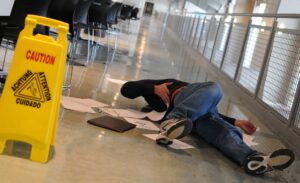
- Slip and Fall Accidents: These often involve liquid spills in supermarkets, icy sidewalks that haven’t been salted within a reasonable timeframe, or “hidden” hazards like loose floorboards and torn carpeting.
- Lead Poisoning and Toxic Exposure: Landlords are legally required to ensure that apartments (especially those housing children) are free from lead paint and mold.
Holding Negligent Owners Accountable
When a landowner puts profit over safety by cutting corners on maintenance or security, the entire community is at risk. Whether it is a multi-billion dollar mall developer, an NYC building manager, or an elevator maintenance contractor, these entities have a non-delegable duty to keep their premises reasonably safe.
KDLM’s New York premises liability lawyers are dedicated to ensuring premises liability victims receive the compensation and peace of mind they rightfully deserve.
If you or a loved one has been injured due to a dangerous condition on a property, contact us today to discuss your legal options and ensure you receive the compensation you deserve for your medical bills, lost income, and long-term care.