



A cancer misdiagnosis lawyer in New York helps patients and families when a doctor missed, delayed or got the diagnosis wrong and the delay let the disease spread. Under New York’s Lavern’s Law, you generally have 2.5 years from when you knew or should have known of the error and that it caused injury, but no more than 7 years after the error. Claims against public hospitals have shorter deadlines.
Kramer, Dillof, Livingston & Moore (KDLM) is a Manhattan medical malpractice law firm founded in 1950. Our trial lawyers have won over 150 verdicts of more than $1 million. If you think your illness was caught too late, call (212) 267-4177 for a free consultation.
Attorney advertising. Prior results do not guarantee a similar outcome.
What counts as cancer misdiagnosis?
Cancer misdiagnosis is a type of medical malpractice where a doctor, radiologist, pathologist or hospital is failing to diagnose a tumor that a careful provider would have found. Most cancer misdiagnosis claims involve a delayed or incorrect diagnosis in one of four forms:
- Missed diagnosis: the disease is never considered, so no test is ordered to detect cancer.
- Delayed diagnosis: a symptom or abnormal result is noticed, but the follow-up comes months or years too late.
- Wrong diagnosis: the tumor is mistaken for a harmless condition, such as a cyst, an infection or hemorrhoids.
- Incorrect cancer diagnosis: a patient is told they have cancer when they do not, and gets harmful treatment while the real illness goes untreated.
Not every late diagnosis is malpractice. Some tumors are hard to find even with good care. A cancer misdiagnosis case exists when the doctor’s negligence, a failure to meet the accepted standard of care, caused real harm.
Why does a delayed cancer diagnosis matter so much?
Because stage at diagnosis drives survival, and a cancer may be far harder to treat once it spreads. Federal data from the National Cancer Institute’s SEER program shows how sharply the odds drop once the disease spreads:
- Female breast cancer: 100% five-year relative survival when localized, 33.8% once it has spread to distant organs.
- Colorectal cancer: 91.3% when localized, 16.9% when distant.
- Lung cancer: 65.5% when localized, 10.5% when distant.
A delay of months can move a patient from the first group to the last. That change, from a curable tumor to an advanced one, is the heart of most failure to diagnose cancer claims and other delayed diagnosis claims.
Diagnostic error is also common. A Johns Hopkins-led study in BMJ Quality & Safety (Newman-Toker et al., 2024) estimated that about 795,000 Americans die or are permanently disabled each year because dangerous diseases are misdiagnosed. Lung tumors were among the top five conditions behind those harms (PubMed abstract).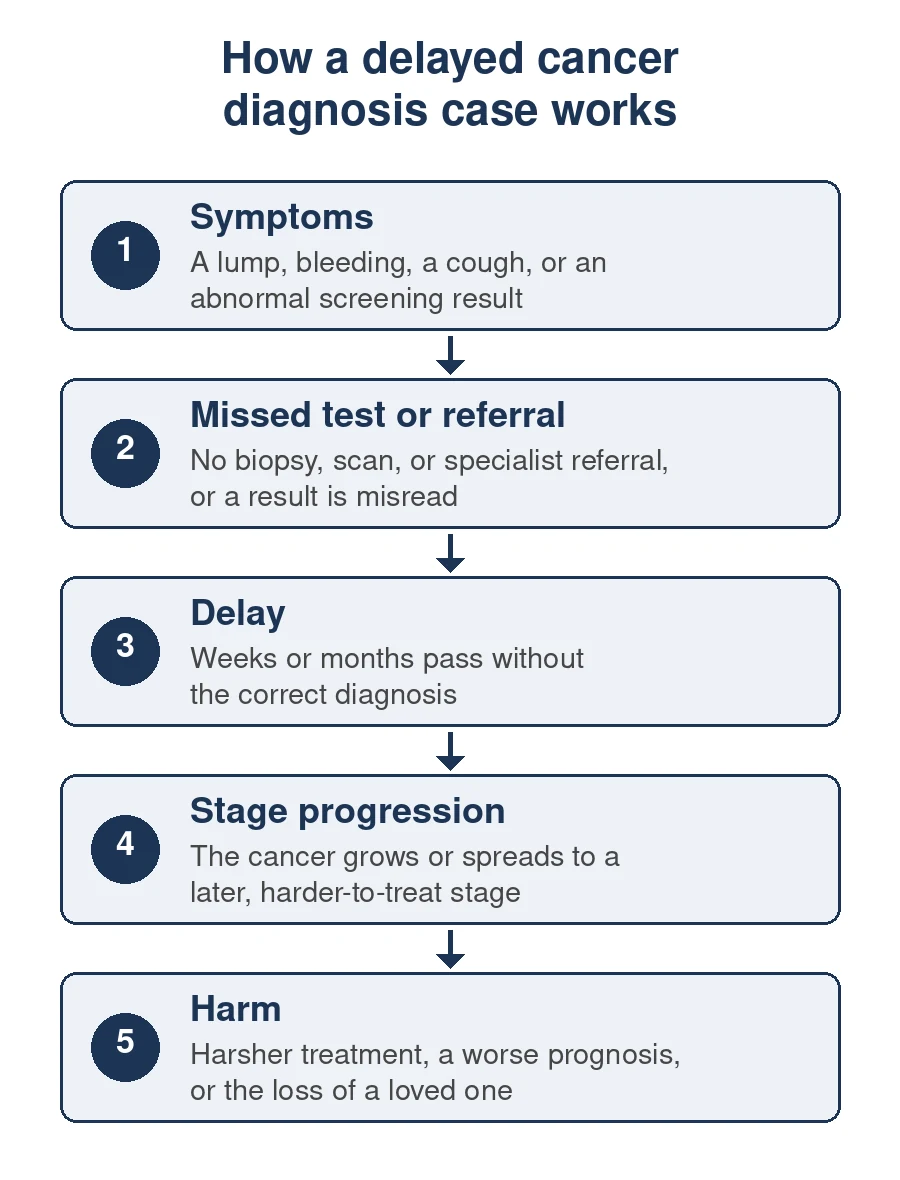
Which types of cancer are most often missed or diagnosed late?
Every cancer type can be missed, but the same patterns show up again and again in cancer diagnoses that go wrong. Here is how the cancer is missed most often:
Breast cancer
A mammogram or ultrasound is misread, a suspicious finding is not biopsied, or a lump in a younger woman is dismissed as a cyst without imaging.
Lung cancer
A nodule on a chest X-ray or CT scan is noted but never followed up, or a persistent cough is treated as bronchitis for months.
Colorectal cancer
Rectal bleeding, anemia or a change in bowel habits is blamed on hemorrhoids, and no colonoscopy is ordered, even in a younger patient.
Cervical cancer
An abnormal Pap or HPV result is never acted on or repeated.
Ovarian cancer
Pelvic pain and bloating are not worked up with imaging or blood tests.
Skin cancer and melanoma
A changing mole is not biopsied, or the pathologist misreads the biopsy slide as benign.
Prostate cancer
A rising PSA result is not repeated or referred to a urologist, so the cancer grows outside the prostate.
Lymphoma
Swollen lymph nodes, night sweats or weight loss are put down to an infection, and no biopsy is done. In each case, the cancer symptoms were there, but no one acted on them.
How do you prove a cancer misdiagnosis lawsuit in New York?
To win a cancer misdiagnosis lawsuit, New York law requires proof of two things: the provider departed from accepted medical practice, and that departure caused the injury. In practice, a strong medical malpractice case answers four questions:
- Standard of care: what would a careful doctor in the same specialty have done with these symptoms or test results?
- The departure: was a test not ordered, a scan misread, a pathology slide misinterpreted, or an abnormal result never followed up?
- The delay: how long was the cancer missed? Your medical records, imaging and pathology slides set the timeline.
- The harm: did the delay change the stage, the treatment you needed, or your life expectancy?
These claims depend on expert testimony from oncologists, radiologists or pathologists. Before you can file a medical malpractice suit, the State of New York requires the lawyer to consult a physician and file a certificate of merit (CPLR 3012-a). So in every case, a qualified medical expert has reviewed the case before the lawsuit is filed.
Defense lawyers often argue the cancer would have spread anyway. That is why the strongest cases show, with expert support, what an earlier diagnosis would have changed.
How long do you have to bring a medical malpractice lawsuit for cancer misdiagnosis in New York?
As background, New York’s general medical malpractice statute of limitations is 2 years and 6 months from the malpractice, or from the last treatment if you kept treating with the same provider for the same condition (N.Y. CPLR 214-a).
Lavern’s Law, added to CPLR 214-a in 2018, changes the start date for a negligent failure to diagnose cancer or a malignant tumor. In those cases, the 2.5 years run from the later of:
- when you knew, or reasonably should have known, of the error and that it caused injury; or
- the date of your last treatment, when there was continuous treatment for the condition.
There is a hard outer limit: a claim based on discovery must be filed no later than 7 years after the error. For context, if a loved one has died, a separate wrongful death claim generally must be brought within 2 years of the death (EPTL 5-4.1).
Claims against a public hospital, such as NYC Health + Hospitals, have shorter deadlines. A notice of claim must be served within 90 days (General Municipal Law 50-e), and the lawsuit must be filed within 1 year and 90 days. In a failure to diagnose cancer case, both of those periods run from the same date: when you knew or should have known of the error and that it caused injury. For more detail, read our guide to the New York medical malpractice statute of limitations. This is a general summary, not legal advice; a lawyer should confirm the dates for your case.
What compensation can a malpractice claim for cancer misdiagnosis recover?
Every case is different. Depending on the facts, damages in a medical malpractice claim for cancer misdiagnosis in New York can cover:
- medical bills, including more aggressive treatment the delay made necessary;
- future care, such as chemotherapy, surgery, home care and medication;
- lost wages and lost future earning ability;
- pain and suffering, including the emotional toll of facing a more advanced cancer;
- for families, wrongful death damages for lost financial support and services.
Case value turns on the stage change, your age, your income and the strength of the expert proof. Our separate guide to cancer misdiagnosis settlements in New York explains what drives settlement value.
What results has KDLM achieved in cancer diagnosis cases?
KDLM has recovered millions for victims of medical malpractice harmed by diagnosis errors, including:
- $3.8 million for a 44-year-old Suffolk County woman after a two-year delay in diagnosing breast cancer.
- $2.8 million for a 43-year-old Manhattan woman after a three-year delay in diagnosing breast cancer.
- $2.5 million for a 51-year-old Queens woman after a two-year delay in diagnosing breast cancer.
- A $7 million jury verdict won by Judith Livingston in Westchester for the family of a 34-year-old woman whose doctors wrongly believed she had ovarian cancer while her treatable pancreatitis went untreated.
See more on our results and recent settlements pages. Prior results do not guarantee a similar outcome.
Why choose KDLM as your New York cancer misdiagnosis attorney?

KDLM has represented injured New Yorkers since 1950. Our misdiagnosis attorneys are trial lawyers in New York, and medical malpractice trials are the core of what this law firm does. Learn about our history.
- Thomas A. Moore has won 95 trials with verdicts over $1 million and has been listed in The Best Lawyers in America since 1989.
- Judith A. Livingston has won 37 trials with verdicts over $1 million. She is a former President of the Inner Circle of Advocates (2022) and a past co-president and board member of the Judges and Lawyers Breast Cancer Alert.
- Matthew Gaier co-authors the three-volume treatise New York Medical Malpractice and a New York Law Journal column on malpractice law with Tom Moore.
These misdiagnosis lawyers handle cancer cases as part of our wider failure to diagnose and medical malpractice practice. We work on a contingency fee: no fee unless we win.
What should you do if you think your diagnosis was missed?
- Put your health first. Get treatment and, if you want one, a second opinion.
- Write down the timeline: first symptoms, each visit, each test and what you were told.
- Request your records, including imaging reports and pathology results.
- Keep bills and pay records showing costs and lost income.
- Talk to a medical malpractice lawyer early, because the deadlines above are strict.
Bring whatever you have to the consultation. You do not need complete records; your lawyer can request them.
Frequently asked questions
Can I sue a doctor for missing my diagnosis in New York?
Yes, if the doctor failed to meet the accepted standard of care and the delay caused harm, such as a later stage or harsher treatment. A medical expert must support the claim before it is filed.
How long do I have to file a cancer misdiagnosis lawsuit in New York?
Generally 2.5 years from when you knew or should have known of the error and that it caused injury, but no more than 7 years from the error itself (CPLR 214-a, Lavern’s Law). Against a public hospital, such as NYC Health + Hospitals, you must serve a notice of claim within 90 days and file the lawsuit within 1 year and 90 days, both counted from that same knew-or-should-have-known date.
How do I know if I have a cancer misdiagnosis case?
Signs include an abnormal test result that was never followed up, symptoms that were dismissed for months, or a scan later found to show the tumor. A lawyer and medical expert review the records to tell you for sure.
Can my family file a claim if a loved one died after a delayed cancer diagnosis?
Yes. The estate can bring a wrongful death claim, generally within 2 years of the death, along with a claim for the pain and suffering your loved one endured before death.
How much does a cancer lawyer cost?
At KDLM, nothing up front. We work on a contingency fee, so there is no fee unless we win, and the consultation is free.
What if I was told I had a tumor and I did not?
An incorrect cancer diagnosis can also be malpractice if it led to unneeded surgery or chemotherapy, or let the real illness go untreated.
What should I bring to my consultation?
Your timeline, the names of your doctors and hospitals, any test results or reports you have, and your insurance and billing records.
Is a cancer misdiagnosis different from a general failure to diagnose?
It is one type of failure to diagnose, but New York gives it a special discovery-based deadline under Lavern’s Law. See our failure to diagnose page for other conditions.
Talk to a New York cancer misdiagnosis lawyer today

If a missed or delayed cancer diagnosis changed your life or took someone you love, call KDLM at (212) 267-4177 or send us your case through our contact form. Our office is at 217 Broadway, 10th Floor, New York, NY 10007. Consultations are free, and there is no fee unless we win.
Attorney advertising. Prior results do not guarantee a similar outcome.